Volkswagen ID. Polo review
Volkswagen’s learnt a lot from its earlier ID cars, and five decades after the Polo originally launched, we get this all-new, all-electric ID. Polo. It shines for its space, driving manners and overall quality, but better still, it could just be the best electric car VW has made to date. But is that enough to make you buy one over other, cheaper electric superminis? Read our Volkswagen ID. Polo review to find out.


Pros
- Huge 441-litre boot
- Top-notch cabin quality and details
- Brisk performance but good economy
Cons
- Can get expensive to buy
- Range can fall short of claims
Interior
Our rating: 10/10
Driving position
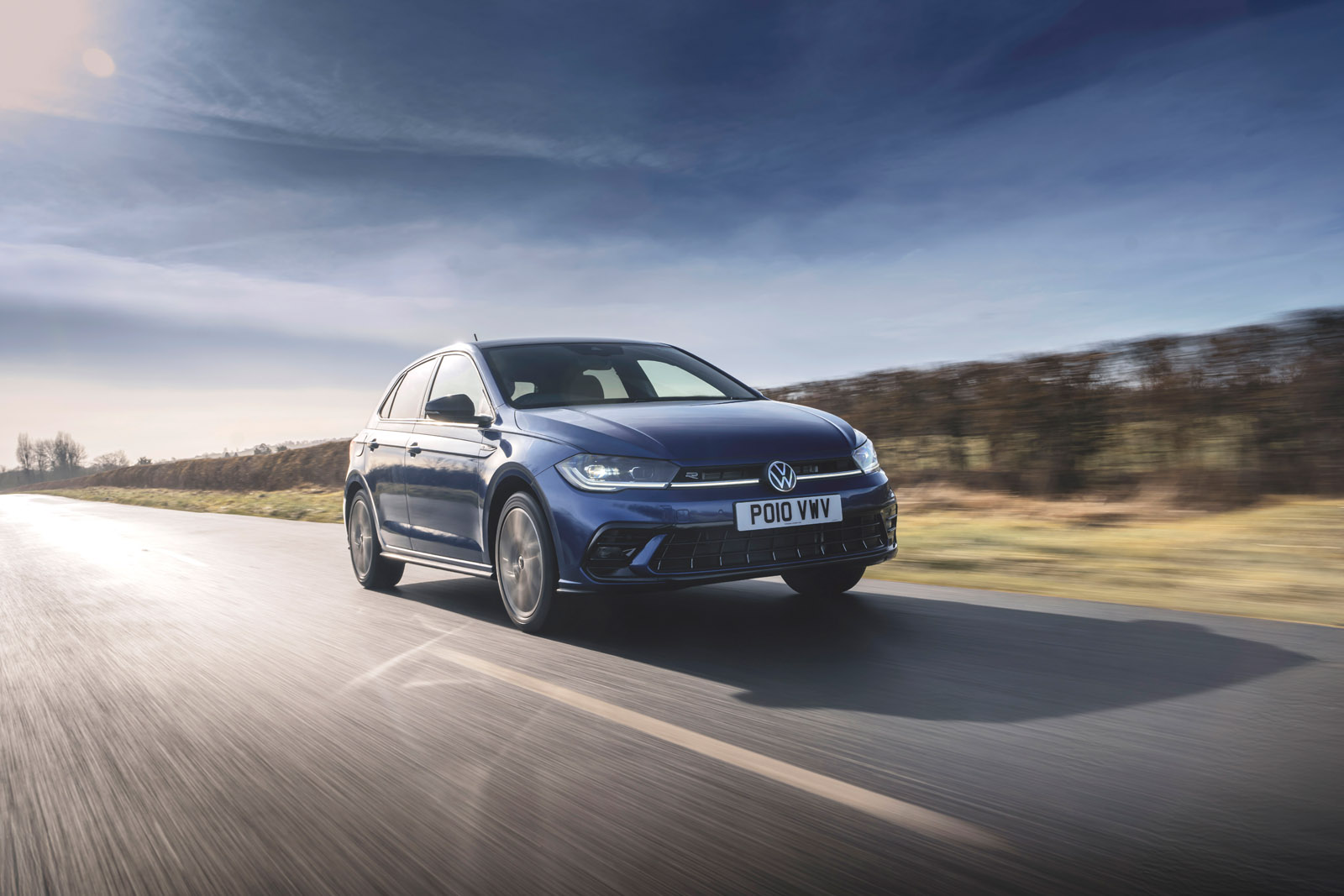
While Volkswagen had previously been criticised for earlier ID-branded electric cars, which felt characterless and sometimes low-budget, the ID. Polo marks a huge step forward.
Some have called it ‘boring in a good way’ – we’d prefer to call it predictable. It feels every bit the Polo it should, and that’s perfect for many buyers who will be upgrading from a petrol-powered Polo.
The driving position feels familiar, with a conventional dashboard layout rather than a bare space, but because it’s built specifically to be an electric car, it’s been packaged to maximise interior space.
It means the battery doesn’t eat into underfloor space too much, so the seat goes plenty low enough. There’s actually a lot of adjustment in the ID. Polo’s seats, with VW promising Golf-levels of space inside.
The steering wheel is something of a ‘squircle’, but it’s round enough not to be as offensive as some of the more obscure designs out there. The shape helps maintain visibility of the driver’s display, but the wheel does feel a touch too big for a supermini if we're nitpicking.
Basically, Volkswagen's drawn on the Polo's 50-year heritage to understand how people really do use their cars, so everything is exactly where you want it, and there’s no steep learning curve for the controls.
Tech and features
Volkswagen ID. Polo trims
– Life
– Life Launch Edition
– Style
– Style Launch Edition
Way back when, base-spec Polos were pretty sparse. We’re talking steel wheels, no air-con, a very basic radio with buttons...
That’s all changed, and the version of the ID. Polo we’d recommend going for is actually the entry-level Life.
Standard kit includes a huge 12.9-inch touchscreen infotainment screen and a 10-inch driver’s display, which shows far more information than the tiny strip you’d get on earlier ID.3 cars.
Keyless entry, front and rear parking sensors, a reversing camera and adaptive cruise control give it everything you need, and of course you’ve got wireless Apple CarPlay/Android Auto.
VW’s particularly fond of its retro mode, which turns the instrument cluster into a fake analogue one inspired by the Mk1 Golf. It’s undoubtedly a gimmick, but it also doesn’t detract from the car, and it’s good to see personalisation being offered on a software level.
Crucially, physical buttons are back by popular demand. Shortcut keys under the screen house climate controls, the steering wheel buttons are proper and not touch-sensitive nightmares, and we’ve finally got four window switches back instead of the unnecessarily awkward ‘rear’ switcher.
Life Launch Edition’s most important additions are heated front seats, a heated steering wheel and dual-zone climate control, but you can also add this on as the ‘Winter Pack’ for Life models for £515.
Style cars get all of these plus VW’s matrix LED headlights (IQ.LIGHT) which adapt not to blind oncoming traffic – plus a few other trinkets here and there.
VW’s options list helps plug the gap between trims if you only want certain upgrades, but the Style Launch Edition is more of an ‘every box ticked’ type of car. Its 360-degree camera is very crisp and clear; there’s a panoramic sunroof, massage front seats, and even self-parking.
Finally, and on the EV front, all cars get vehicle-to-load (V2L), which lets you power portable devices at up to 3.6kW using the car’s high-voltage battery. Perfect for camping trips or just a lakeside barista-quality coffee.
Performance
Our rating: 9/10
Electric motors and power
Volkswagen ID. Polo performance stats
– Power: 116hp, 135hp or 211hp
– 0-62mph: 7.1 to 10.6 seconds
– Top speed: Up to 99mph
– Driven wheels: Front-wheel drive (FWD)
The ID. Polo also feels familiar in terms of power output – the 116hp and 135hp motors offer a 0-62mph time of 10.6 seconds and 9.5 seconds, which is right in the ballpark of what you’d expect from a Polo.
Both are actually faster than the 80hp and 95hp 1.0-litre engines offered in the outgoing model, but they were slow and very slow. They’re more in line with the 115hp range-topper.
Then, you’ve got the mighty 211hp motor, which is good for a timed sprint in 7.1 seconds. That’s more than fast enough for this type of car – and it felt it in our testing.
Our pick would probably be the 135hp motor for town drivers, but anybody who wants maximum performance should consider the considerable upgrade that is the 211hp motor – or the ID. Polo GTI, which only has a marginally higher 226hp output.
Eco, Comfort, Sport and a configurable Individual mode give the ID. Polo a slightly different feel, but the 211hp model we tested was so punchy that we left it in Eco.
Handling and ride comfort
Based on a new architecture, the ID. Polo marks the return to front-wheel drive. Previous ID cars used rear-wheel drive – this is just another way the electric Polo feels highly familiar.
On the whole, the ride was as composed as you’d expect from any VW. Wind noise was kept low, but tyre noise felt a little bit more than we’d have expected.
Then again, this is a very affordable electric supermini, and our ears are also hyper-sensitive in EVs because there’s no noisy engine.
We tried Style Launch Edition’s upgraded 19-inch alloys (it usually comes with 18s), and the ride was considerably firmer than the same car in Life Launch Edition with 17s. If you prioritise comfort, Life is the one to go for. Plus it’s just such good value overall.
It’s worth noting that you can choose to drive with zero regenerative braking if you prefer a more conventional feel, or two levels of regenerative braking.
Both of those bring the car to a complete stop, so you can maximise one-pedal driving, which is something previous ID cars didn't have. It’s everything we could ever have asked for, and it makes the ID. Polo highly intuitive to drive.
Practicality
Our rating: 10/10
Boot space
Volkswagen ID. Polo boot space:
– Boot space: 441 litres
– Incl. rear seats folded: 1,240 litres
At 441 litres, the ID. Polo’s boot is absolutely massive. It’s 90 litres bigger than the petrol Polo’s, and bigger than some hatchbacks and SUVs from the class above.
It really excels compared with rivals like the Renault 5 (326 litres) and Citroën ë-C3 (310 litres) – and leaves the MINI Cooper Electric (210 litres) in the dust.
The normal space on top of the boot floor all feels pretty normal, but it’s what underneath that counts. A huge storage area that Americans would call a ‘subtrunk’ – we don’t have the exact figures for this, but it’s similar in space to the Tesla Model 3’s ‘subtrunk’ and the Ford Puma Gen-E's GigaBox under-floor storage.
Rear seats
Even though the ID. Polo is around 2cm shorter than the petrol Polo, it’s far more spacious inside.
No engine means the wheelbase can be extended, maximising passenger space.
Two adults should be able to sit in the back pretty comfortably, but there’s no shying away from the fact that this is a small hatchback, so three abreast isn’t realistic.
Compared with the Nissan MICRA and MINI Cooper Electric, it’s considerably better.
Storage solutions
There’s no quirky EV design in here – we’ll say it again, it feels familiar.
It’s just like the regular Polo inside, so you’ve got two cupholders in the centre console, a wireless charging tray for your phone and the usual armrest, glove box and door bin storage.
Volkswagen ID. Polo dimensions
– Height: 1,530mm
– Width: 1,816mm (excl. door mirrors)
– Length: 4,053mm
– Kerb weight: Up to 1,576kg
Towing
The ID. Polo is one of the few electric superminis that can tow, though this only applies to the more expensive big battery model. Still, at 1,200kg, it’s enough for trailers and even small caravans.
It’s also very useful for towbar-mounted bike racks.
Safety
A Euro NCAP safety rating hasn’t been issued yet, but the electric Polo has everything you’d expect. Autonomous emergency braking, traffic sign recognition, airbags, ISOFIX child seat fittings.
We especially like the integrated driver attention monitoring camera, which sits behind the rear-view mirror glass.
It’s far classier than a bolt-on piece of plastic that you get in most other cars.
Running costs
Our rating: 9/10
Range and charging
Volkswagen ID. Polo: electric range, battery and charging
– Range: 200 to 281 miles
– Battery size: 37 to 52kWh
– Max charging speed: 88 to 105kW
– Charge port location: Front right
– Charge time (AC): 5.5 hours (37kWh) to around 7.5 hours (52kWh) with a 7kW charger
– Charge time (DC): 10-80% in 23 to 24 minutes
– Efficiency: 4.5 mi/kWh (claimed)
Let’s start off with charging, because both batteries are so small that an overnight 7kW top-up is ideal. They support 11kW connections, but these are less common and not typically installed at homes, hence us quoting 7kW times.
Small batteries also help rapid charging, because despite slow-sounding 88kW and 105kW charging speeds, a 10-80% top-up in 24 minutes or under is ideal, and a good five to 10 minutes quicker than key rivals.
Now onto real-world range, because those figures might be a bit optimistic. VW claims 281 miles of range for the 52kWh battery – compared with 259 miles for the 52kWh Renault 5.
But that requires averaging 4.5 mi/kWh, which could be a small stretch. We got 3.8 to 4.2 mi/kWh, so a touch under.
Reliability
VW’s electric cars are already very mechanically reliable, with the brand having sold thousands of its own and thousands more from sister companies CUPRA and Audi.
What the brand struggled with the most in its earlier ID.3, ID.4 and ID.5 cars was software reliability and an overall feeling of cost-cutting.
This has seriously improved, with VW’s software now extremely responsive and feature-packed, plus the cabin quality feels much higher with more detail in the fit and finish.
It’s proof that VW has acted on early feedback, but it also makes the ID. Polo one of the best ID cars on sale today.
The verdict
Interior
10/10
Performance
9/10
Practicality
10/10
Running costs
9/10
If you can’t already tell, we’re obsessed with the VW ID. Polo.
It’s not the quirky electric model that we could’ve expected years ago, and it now feels just like your ordinary, high-quality Polo with cheaper running costs and an even more premium design.
Its spacious interior makes it a viable option for a family’s only car, and hi-tech V2L and driver aids make it useful day-to-day, plus we love how much kit is actually included as standard despite its competitive price point.
A competent drive and good real-world efficiency make it relaxing to drive, but as with any EV, we’d take its on-paper range figure with a pinch of salt.
Our only gripe would be how expensive it can become with all the bells and whistles, but it’s not a wholly valid argument because entry- and mid-spec cars are everything you’ll ever need.
Similar to the review