Hyundai i20 review
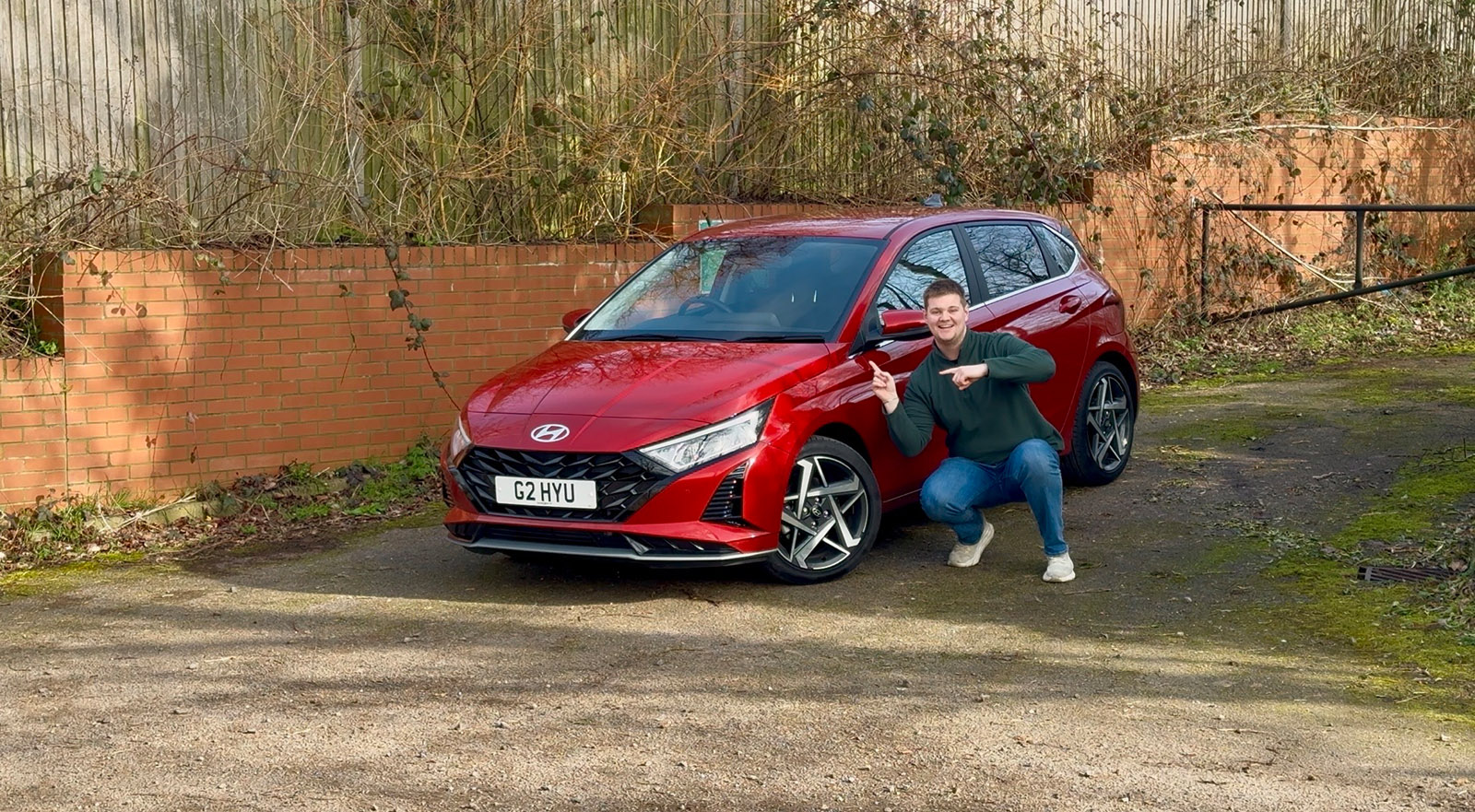
The small, humble hatchback is somewhat of a rarity in 2026. Almost all cars these days are big, heavy SUVs that act as nothing more than a white good. Hyundai, we suspect, knows this, which is why it still sells the i20 – a nimble hatchback with a manual gearbox and an old-school handbrake. But is it still worth buying today? Read our full Hyundai i20 review to find out.

)
Pros
- Genuinely practical boot
- So easy to drive and live with
- An ideal interior layout
Cons
- Only one engine option
- Can feel underpowered at times
Interior
Our rating: 8/10
Driving position
What makes the Hyundai i20 so appealing – aside from its price and looks – is its seating position, which has a sporty hot hatchback feel while still being comfortable.
Even for drivers over six feet, the steering wheel position is spot on, and the manual seat adjustment is a breeze.
Visibility front and back is no problem, and the car is so small you feel as though you can touch the windscreen and rear window at the same time, making parking this hatchback really rather easy.
Tech and features
Hyundai i20 trims
– Element
– Black Line
– Tech Line
– N Line S
There are a number of trims available on the i20. Our Tech Line spec car didn’t feel as though it was missing anything, and it’s not even top spec.
You get two 10.25-inch screens, a reversing camera, front and rear parking sensors and a wireless phone charger. Step up to the top-spec N Line S, and this adds a Bose premium sound system, among other features.
The infotainment system itself is pretty good, but far from as smooth as what you’d find in a Tesla or JAECOO these days.
And while it has Apple CarPlay and Android Auto, it is via a USB-A wired connection only, which is a shame. All cars should have the wireless option available now.
But where it lacks here, it more than makes up for with its wide range of actual buttons throughout the cabin and physical climate controls, which make it so much safer to operate basic functions while driving.
Performance
Our rating: 8/10
Engines and power
Hyundai i20 performance stats
– Power: 90hp
– 0-62mph: 11.1 to 12.8 seconds
– Top speed: 117mph
– Driven wheels: Front-wheel drive
Power comes from a 90hp 1.0-litre, three-cylinder turbocharged petrol engine mated to either a six-speed manual or seven-speed DCT automatic gearbox.
Our test car had the manual, and it was a treat. It’s rare to find three pedals in a car this new, but Hyundai still thinks it's important for its buyers. Every gear change feels good, and it adds to its sporty feel (without being sporty).
However, we suspect most people will opt for the automatic because it’s easier to live with and offers really smooth and quick gear shifts, thanks to the dual clutches.
The engine itself is peppy but not fast. The turbocharger makes a massive difference when overtaking or joining a motorway, though. We drove a naturally aspirated 1.0-litre Kia Picanto last year and found it lacking any oomph in almost all scenarios.
Yes, the i20 has a Sport mode, but it doesn’t do a whole lot. Had this been a Hyundai i20 N, things would be drastically different.
Handling and ride comfort
Despite not being the full-fat i20 N, the standard car does ride very firmly. You’ll certainly feel all the bumps at lower speeds, most of which are ironed out a bit more at higher motorway speeds.
We suspect this is mostly due to the rubber band thin tyres, which compromise on comfort, especially on pothole-y UK roads.
But low-speed ride quality aside, the steering is sublime. It’s direct and sporty, making it feel like you’re driving a much quicker car than you are.
It’s great fun to thread down a country lane, and when you get onto more sensible and boring roads, the steering tightens up a bit to encourage minimal inputs.
Practicality
Our rating: 8/10
Boot space
Hyundai i20 boot space:
– Boot space: 352 litres
– Incl. Rear seats folded: 1,165 litres
There’s a genuinely big boot for its size, at 352 litres. It’s both deep and wide, with no loading lip, making it incredibly easy to load larger items in.
This puts the Ford Fiesta (311 litres) to shame, but if you want more space, a Renault Clio (391 litres) may be a better choice.
If you need more space in the i20, fold down the rear seats to reveal 1,165 litres of total capacity.
Rear seats
We’re pleased to report that there’s loads of space in the rear seats for this size car. It may not look like it from the outside, but you can fit passengers above six feet in there, no problem.
Three may be a squeeze, but it’s certainly possible.
Storage solutions
It’s a small car, but that doesn’t mean it lacks storage space. The main area is the central storage under the armrest, which is big enough for some glasses, a wallet and a phone, etc.
The door bins are decently sized, and the glovebox too.
You can’t go into one expecting it to be like the Tardis, but we think it stacks up well among its rivals.
Hyundai i20 dimensions
– Height: 1,450mm
– Width: 1,775mm
– Length: 4,065mm
– Kerbweight: From 1,065kg
Safety
The Hyundai i20 scored four out of five stars at its 2021 Euro NCAP safety test, which puts it in line with the Peugeot 208 and Vauxhall Corsa, but below the VW Polo and Renault Clio.
In terms of kit, every i20 comes with six airbags, autonomous emergency braking, lane keep assist and Forward Collision Avoidance.
Move up the trims, and you unlock blind spot warning, Forward Collision Avoidance for junctions and Lane Follow Assist.
Running costs
Our rating: 9/10
Fuel economy
As you’d expect from a small-engined, lightweight car, fuel efficiency is great. Hyundai claims it’ll get up to 52.3mpg, which you’d certainly expect to see on a steady motorway stint.
We tested the i20 on some fast and twisty roads in North Hertfordshire, and averaged 35mpg, growing to healthy numbers past 40mpg on calmer stretches of road.
Manual models should return higher figures, with a claimed 53.2mpg over the automatic’s 52.3mpg.
Reliability
Being a Hyundai, there’s almost no need to even fret about reliability.
Not only are they solidly built, but they also get a five-year/unlimited-mile warranty as standard – one of the best in the business.
The verdict
Interior
8/10
Performance
8/10
Practicality
8/10
Running costs
9/10
Should you buy a Hyundai i20 then? Well, yes, absolutely.
If you’re in the market for a small hatchback that’s got lots of space, plenty of tech, is fun to drive and looks smart – this is a great option.
Sure, it may not be quite as fun to drive as a Fiesta or as practical as a Clio, but it’s incredibly reliable and inexpensive to run.
Similar to the review