Volvo EX30 Cross Country review
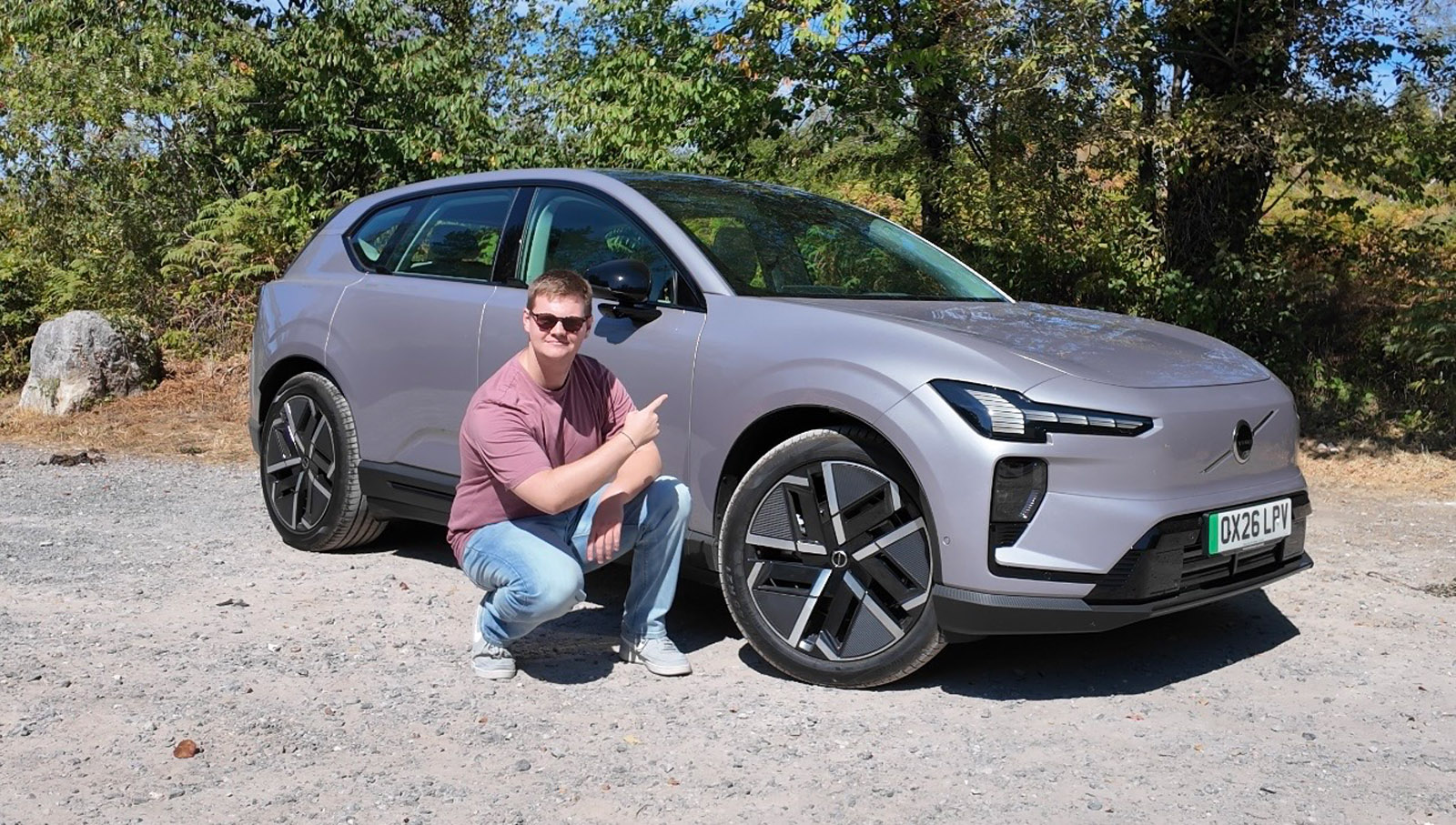
The EX30 is one of Volvo’s most popular electric cars, so it came as no surprise when a Cross Country variant was added. This gives you extra cladding, a ride height increase, more power and (optional) chunkier tyres. But is all this worth it for a four-figure premium? Read our Volvo EX30 Cross Country review to find out.

)
Pros
- Cool styling
- Blisteringly quick
- Raised ride height is useful
Cons
- Quite pricey (when new)
- Could have more electric range
- Ready for off-roading? We’re not sure
Interior
Our rating: 8/10
Driving position
If we’re totally honest, the driving position in the EX30 Cross Country is close to perfection for this type of car. We like to sit nice and low and bring the steering wheel towards us, and this does that without breaking a sweat.
A lot of electric cars force you to sit too high up, which is great if you want a wide view of the road ahead, but less so if you want to feel connected to the car.
Even in the lowest position, you can see a lot around you, and the windscreen is tall, so you don’t feel cramped. The large sunroof helps with this too, making the interior feel much bigger than it is.
Tech and features
Volvo EX30 Cross Country trims
– Plus
– Ultra
Unlike the basic EX30, the Cross Country sticks to the two higher trims, ditching the entry-level Core model completely.
This gives you more for your money. Plus models get basically everything you’d want in a modern car, from heated seats and a powered tailgate to ambient lighting and a 12.3-inch portrait screen (with wireless Apple CarPlay and Android Auto).
Built into the screen is Google software, meaning you have access to native Google Maps and Gemini without even connecting your phone.
This is especially handy when planning a longer journey with multiple charging stops because the system knows how much range you have left at any given point and will factor it into the journey.
Move to the top-spec Ultra, and you get a panoramic sunroof, a 360-degree parking camera, tinted rear windows and Park Pilot Assist.
While we’re generally fans of the interior layout and its ergonomics, there are two downfalls we should elaborate on.
Firstly, the screen is used to control absolutely everything in the car. If you want to change any setting, it’s all done via the screen – a tricky task while driving.
Granted, Volvo has made sure it’s as easy as possible, but some physical climate control knobs would be a welcome addition, even if it disrupts the Scandi-chic.
Another small gripe is the storage area between the driver and front passenger. It feels very cheap and plasticky – because it is. And there’s a small gap between it, so you’ll often lose smaller items down there without realising, resulting in a faff to unclip the cheap plastic doors to get them out.
Performance
Our rating: 9/10
Electric motors and power
Volvo EX30 Cross Country performance stats
Power: 428hp
0-62mph: 3.9 seconds
Top speed: 112mph
Driven wheels: AWD
There’s no denying the EX30 Cross Country is quick. Really quick.
The top model has a twin-motor setup (giving it all-wheel drive) with 428hp and a 0-62mph time of just 3.9 seconds, which you certainly feel from your eyes right down to your stomach when you stamp on the accelerator.
There are three drive modes to choose from: Range, Standard and Performance. In our testing, we found Range to be redundant (it didn’t really do much), so we left it in Standard almost all of the time.
Though, if you fancy a giggle, switch it into Performance mode, and you’ll be left crying with laughter at how insanely and unnecessarily fast it is in a straight line.
Handling and ride comfort
Because most EV buyers are going to live in and around cities, we decided to drive the EX30 into the centre of London for a meeting instead of taking the train – just to see how it copes.
And the results were as we expected. It’s by no means a big car, so zipping down tight side streets is easy, and because you can sit quite high up, you can see everything around you.
Because of the added 20mm ride height, it soaks up bumps much better, too. The standard EX30 is already a comfortable car, but this takes it up a notch.
Then, to test the long-distance capabilities, what better than a 300-mile round trip down to Somerset? Aside from the usual Stonehenge traffic (every single time...), the car was incredibly comfortable sitting at 70mph most of the way down.
It feels well connected to the road despite sitting higher than the standard car; the suspension handles uneven road surfaces well, and it’s generally a refined experience. Adaptive cruise control certainly helps.
As for off-road? We don’t think the Cross Country will be entering the Dakar Rally anytime soon, but it can handle lighter stuff.
Most buyers will never take it more off-road than parking in a field for a music festival, so if you’re going to be doing that, you needn't worry.
Practicality
Our rating: 8/10
Boot space
Volvo EX30 Cross Country boot space:
Boot space: 318 litres
Incl. rear seats folded: 904 litres
Front boot (froot): 7 litres
Up until now, we’ve only sung the EX30’s praises, but where it’s let down slightly is the boot space.
There’s 318 litres (904 litres with the rear seats folded), which is fine but no more than that.
This is behind rivals such as the smart #1 (323 litres), Kia EV3 (460 litres) and Renault Megane E-Tech (440 litres).
Then there’s the frunk, or should we say the pocket? It’s the car equivalent of those tiny pockets on a pair of jeans. What are they even for?
It’s seven litres. We’re not entirely sure what you store here because the charge cables don’t even fit.
Perhaps a loaf of bread? A pencil? Seven one-litre water bottles?
By comparison, the much smaller Geely EX2 hatchback has a 70-litre froot, which shows what can be done with clever packaging.
Rear seats
We must remember the EX30 is not a big car, even if it portrays itself as one, so it’s best to get into the back thinking it’s a large hatchback, instead of a fully-fledged SUV.
Legroom could be better, and there isn’t much under-thigh support, but headroom isn’t too bad – helped by the panoramic sunroof.
There are also reasonable door bins and a storage area between the front seats where the armrest cubby hole would normally be. You can access this from the back, too.
Storage solutions
Space-wise, there’s a centrally mounted glovebox, which in itself is strange, but it can also only be opened via the touchscreen. Why? We’re not sure.
There’s also the central storage cubby we touched on earlier, which has its own drawbacks, but to be fair, it can store a lot of stuff.
You’ll also find two cup holders hidden inside the armrest that slide out at the touch of a button.
Volvo EX30 Cross Country dimensions
Height: 1,573mm
Width: 1,953mm
Length: 4,233mm
Kerb weight: 1,960kg
Safety
Volvo is known for a couple of things, including a premium interior and a refined drive, but most people associate the brand with safety.
Euro NCAP crash-tested the EX30 in 2024, and it passed with a full five-star rating, but every Volvo since 2009 has been awarded the full five stars, so we’re not surprised.
You get the usual modern array of driver assistance features, including an attention awareness sensor that’s likely to nag you more than your child in the back seat, but that’s quickly becoming the norm as safety regulations get ever tighter.
Pilot Assist is also a standard-fit feature, which includes adaptive cruise control and steering assistance with lane-change assist.
Running costs
Our rating: 8/10
Volvo EX30 Cross Country: electric range, battery and charging
Range: Up to 288 miles
Battery size: 69kWh
Max charging speed: 153kW
Charge port location: Back left
Charge time (AC): 0-100% in 10 hours
Charge time (DC): 10-80% in 28 minutes
Efficiency: 3.4 mi/kWh
The base model EX30 has a claimed range of 214 miles, so we were delighted to find out the Cross Country extends that to around 280 miles on a single charge thanks to the bigger 69kWh battery. It’s still not a lot by today’s standards, but it’s more efficient than you think.
Volvo claims the P8 performance model will return 3.4mi/kWh, but over 400 miles we achieved 4.0mi/kWh. That pushes it into Tesla levels of efficiency – the industry benchmark.
And once the battery needs charging back up, it can do so at up to 153kW, resulting in a 10-80% charge in less than 30 minutes.
Alternatively, you can charge at home and get a full charge in around 10 hours while you sleep.
By comparison, the Kia EV3 gets 375 miles, the Hyundai Kona Electric has 319, and the smart #1 can do up to 273 miles on a charge.
Reliability
Being a Volvo, you aren’t going to need to worry about reliability – they’ve been really solid cars for years, and the electric ones are no different.
Additionally, you get a three-year/60,000-mile warranty as standard, which is about the standard you get with a new car in the UK.
The verdict
Interior
8/10
Performance
9/10
Practicality
8/10
Running costs
8/10
The Volvo EX30 Cross Country takes an already popular formula and cranks it up with rugged looks, extra ground clearance and an absurd 428hp performance option that will leave you giggling like a tickled baby.
The raised ride height is a genuine upgrade for smoothing out cracked city streets and long-distance driving, while the standard Plus and Ultra trims mean you get high-end tech – like built-in Google software – right out of the box.
However, at roughly £8,000 more than the entry-level EX30 and up to £1,400 more than the equivalent non-Cross Country EX30, it’s a pricey upgrade. It doesn't fix the car’s main flaws: the tiny 318-litre boot, comical seven-litre frunk, cramped rear legroom and a screen-reliant dash that desperately needs a few physical climate knobs.
It’s also built more for festival fields than the Dakar rally, but if you want a sub-four-second EV with punchy Scandi styling, incredible real-world efficiency and a plush ride position, you’ll love it.
But if pure value and boot space are top of your list, you may want to consider a Kia EV3. Alternatively, consider a Volvo EX40. It has all the same qualities as an EX30 but with a bigger boot.
Similar to the review