Ford Focus review (2018-2025)
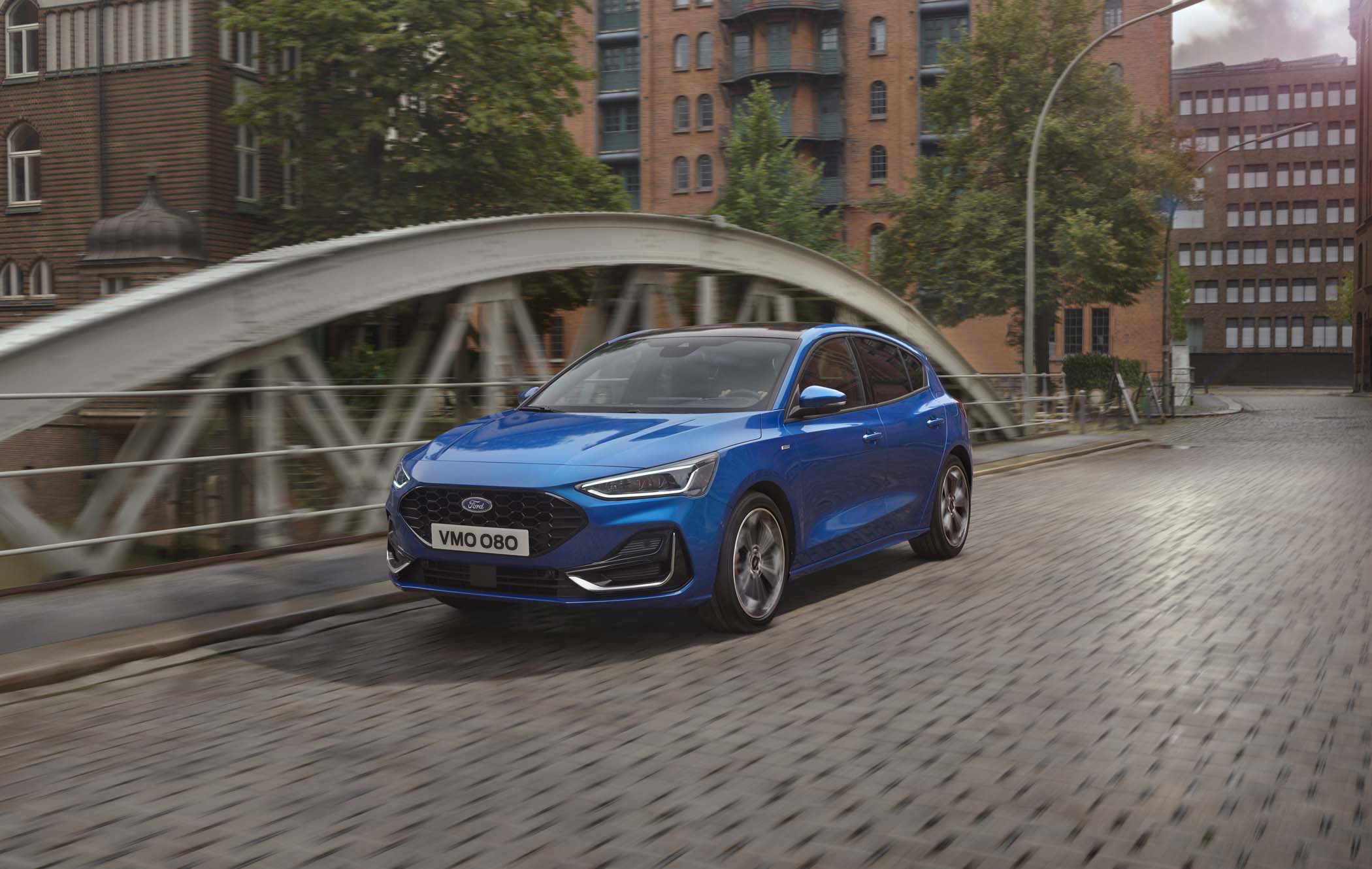
The Ford Focus has been one of Britain’s go-to hatchbacks for more than a quarter of a century, and is popular for its sporty handling and comfortable ride – a balance that many manufacturers struggle to get right. But is this the right buy with fresher, more modern hatchbacks also available? Read our Ford Focus review to find out.

)
Pros
- Excellent handling
- Superb EcoBoost petrol engines
- Wide choice of trims to suit everyone
Cons
- Other hybrids are more efficient
- Some base trims are pretty empty
Interior
Our rating: 7/10
Driving position
The Ford Focus has an exceptional drive thanks to a suitably sporty yet comfortable driving position.
Compared with other hatchbacks that can feel a bit vague and unsupportive, the seating position in the Focus is low and sporty (but you can still sit higher if you prefer).
There’s also lots of adjustment in the steering wheel, so it’s easy to get comfortable whatever your preferred seating position is.
All-round visibility is good, and slim A-pillars (between the windscreen and the front doors) really help when pulling out at junctions.
Rearward visibility is more acceptable than class-leading, but it's not a difficult car to drive in any regard, and widely available sensors and cameras take the pressure off anyway.
Tech and features
Ford Focus trim levels
– Style
– Zetec (Edition)
– Trend
– Titanium (Edition)
– Titanium X (Edition)
– Titanium Vignale
– Active Style
– Active (Edition)
– Active X (Edition)
– Active Vignale
– ST-Line (Edition)
– ST-Line X (Edition)
– ST-Line Vignale
– Vignale
This particular generation of Focus has seen countless model year changes, including a major facelift in 2022, so what you get can vary a lot.
Some of the earlier entry-level trims feel pretty sparse, coming with little more than a basic radio.
The eight-inch touchscreen fitted to most of the trims is extremely easy to use and looks like a tablet in terms of software.
It runs Ford’s SYNC 3 software, but most importantly, it comes with wired Apple CarPlay/Android Auto. There’s a smaller 6.5-inch version of this display on some mid-level trims.
The much bigger 13.2-inch SYNC 4 screen fitted to post-facelift models is a major upgrade, adding wireless smartphone projection.
A digital instrument cluster also replaces the physical dials with this system.
In terms of trim level, we suggest avoiding the lower-end options and going down one of the three routes Ford sets out – luxurious Titanium-branded versions, sporty-looking ST-Line models or high-riding, crossover-inspired Active variants.
The naming changes a lot by model year, sometimes including ‘Edition’ and sometimes not. The addition of ‘X’ or ‘Vignale’ to the end of a trim level denotes it sits further up the hierarchy, so comes with more kit.
Titanium-branded models are extremely popular, and can come with features like heated seats, a heated steering wheel and wireless charging.
Performance
Our rating: 7/10
Engines and power
Ford Focus performance stats
– Power: 85hp to 182hp
– 0-62mph: 8.3 to 13.9 seconds
– Top speed: 109 to 138mph
– Driven wheels: Front-wheel drive (FWD)
Ford’s ‘EcoBoost’ turbocharged petrol engines are also spoken about favourably by owners, and for good reason. They’re genuinely efficient, and are actually pretty quick.
The most popular power outputs are the 125hp and 155hp models, with or without mild hybrid tech depending on age. There are also 85hp and 100hp models, but they feel slower.
Before the 155hp 1.0-litre engine was added, there was also a 150hp 1.5-litre petrol engine. A more powerful 182hp version was dropped in the name of efficiency.
Most diesel engines are 120hp 1.5-litre EcoBlue units, but there are also some less powerful 95hp models floating around and the odd 150hp 2.0-litre diesel.
We think the more powerful 1.0-litre EcoBoost engines offer the best balance of performance and efficiency, and thankfully they’re easy to come by on the used market.
If you fancy yourself some more performance, there’s also the Focus ST which is a slightly separate car with its own unique handling traits. There are 280hp 2.3-litre petrol and 190hp 2.0-litre diesel versions of this hot hatch.
Our pick: Ford Focus 1.0 EcoBoost mHEV 125hp
Handling and ride comfort
It might have been discontinued in 2025, but we think the Ford Focus is still one of the best-handling family hatchbacks out there.
It’s got sharp and predictable steering and firm enough suspension not to feel numb on a twisty road.
ST-Line models have stiffer suspension and bigger alloys, so they’re generally less comfortable, which is why Titanium-branded models are as popular as they are.
The Focus is perfectly quiet on the motorway, but the Volkswagen Golf is a little more refined at speed.
Practicality
Our rating: 7/10
Boot space
Ford Focus boot space
– Boot space: 375 litres
– Incl. Rear seats folded: 1,354 litres
The 375-litre boot is exactly what we want from a family hatchback – it’s about average, with cars like the VW Golf offering five more litres.
An optional hands-free electric boot is a nice-to-have, but the opening is wide and usable across the board.
Rear seats
Compared with previous versions of the Focus, rear passenger space has drastically improved.
It’s not quite as spacious as a Honda Civic in the back, but it certainly gives the Golf a run for its money and is more usable than a Peugeot 308.
Storage solutions
Being a family-focused hatchback, the Focus has a few tricks up its sleeve, such as large door bins and a fair amount of storage in the centre console.
Ford Focus dimensions
– Height: 1,502mm
– Width: 1,979mm (incl. mirrors)
– Length: 4,397mm
– Kerbweight: Up to 1,404kg
Safety
Euro NCAP awarded the Ford Focus a full five-star safety rating, noting strong adult and child protection scores.
Autonomous emergency braking, lane-keep assist and traffic sign recognition are generally standard on newer cars.
The optional matrix LED headlights are a worthwhile upgrade, illuminating as much of the road as possible without blinding oncoming traffic.
Running costs
Our rating: 7/10
Fuel economy
Fuel economy depends on the size of your engine more than the power output, so whichever version of the popular 1.0-litre EcoBoost you go for, you’ll generally get around 40-50mpg on a longer run.
Knock 10mpg off for the 1.5-litre petrol, and add 10mpg to the diesels, as a general rule.
The mild hybrid system reduces emissions in newer models, but it doesn’t do much for real-world fuel economy in practice.
Hybrid alternatives, like the self-charging Toyota Corolla or plug-in hybrid Volkswagen Golf, offer cheaper running costs.
Reliability
Ford has been using the same EcoBoost and EcoBlue engines across most of its range for years. Their popularity and the sheer volume of Focus cars sold speak volumes.
In terms of software, the SYNC 4 screen is generally more responsive than older SYNC 3 systems. Newer cars also get over-the-air (OTA) updates to keep things in running order.
The verdict
Interior
7/10
Performance
7/10
Practicality
7/10
Running costs
7/10
The Ford Focus remains a truly excellent family hatchback option in an SUV-dominated world, with sharp handling, a comfortable enough ride and all the family essentials you could need.
The broad array of trim levels can be daunting at first, but given the car’s affordability, it’s easy to stretch to higher specifications for maximum value, such as Titanium or Titanium X.
And speaking about the best options, post-facelift cars feel like a big step forward thanks to a more tech-forward cabin, wireless smartphone mirroring and stronger levels of standard equipment in general.
If you want a hatchback that’s consistently good across all categories and you don’t want it to cost the earth to buy or run, then the Focus still makes a really strong argument for itself.